

By: Laura Moreno
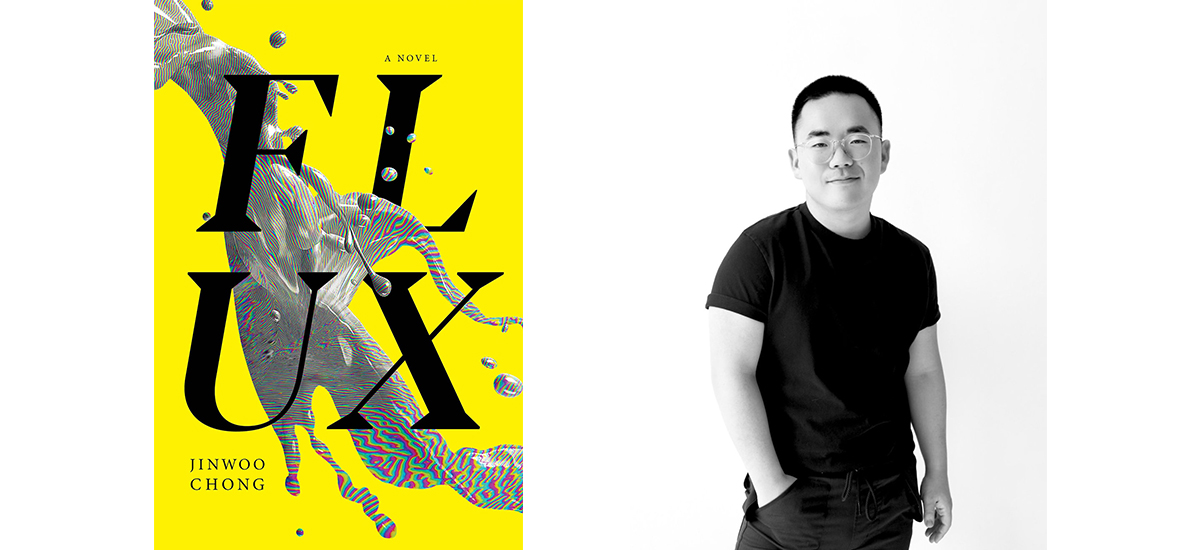
Jinwoo Chong’s new futuristic debut novel is like no other book you’ve ever read. (Ling Ma’s “Severance” may be, however, the closest thing.) Written in the tech thriller genre, it is a masterful example of what just may be the literature of the future.
In many ways the intricately constructed world of “Flux” unfolds more like a film than literature. Even though the novel grapples with dark issues, the sci-fi page turner is delivered in the stylish packaging of pop culture. Call it “dystopian lite.”
Given the labyrinth-like plot structure, readers need to be prepared to remain alert to small clues in Chong’s vividly descriptive prose that prove crucial to understanding this breathtakingly complex story. It’s all there on the page, but there is a risk that inattentive readers may become confused.
Or at least this was the reason given for why the novel was rejected by publishers before it found a home with its prestigious publisher Melville House. Unbelievably, Jinwoo Chong said in an interview that he almost gave up on publishing “Flux,” imagining the editors must be right.
The story intertwines the lives of the three main characters: Brandon, a gay young half-Korean man who at 28 has just lost his job; Blue, a 48 year old key witness in a criminal case against a tech startup; and Bo, an 8 year old boy who has just lost his mother in a tragic accident.
Right before Christmas, Brandon is laid off from his marketing job. Before he can even leave the building, Brandon literally steps right into a new job working for a shady company led by a mysterious character named Lev. Everyday Brandon gets up, has breakfast, goes to work, and then can’t remember a single thing about his entire day. Nonetheless, his instincts remain sharp. He soon begins to suspect his new employer is using time travel to cover up a slew of violent crimes.
This is a world in which “structural inadequacy” has been normalized. Mind blowing secret technologies enable constant sleights of hand under the radar. Everyone is being played and facts are regularly manipulated. The lucky few have good jobs in dying industries and are rewarded for figuring out how to fleece their customers. Everyone else is homeless, having been replaced by technology. It’s a potentially civilization-ending future in which everything is in flux.
Grief, anguish, cruelty are everywhere, as are the absolutely ridiculous people that such a civilization gives rise to. Why, for example, does the workplace lobby have TV screens announcing the latest tragedy, “18 trains derailed during the blackout” as if it were useful or beneficial information to the workers? In fact, marketing fear to the public in this way only underscores the incompetence (or creative destruction? mere cruelty?) of the authorities.
“Flux” also contains glimpses into the medical tyrrany currently taking shape, along with its extreme commercialization. Notably, implanted medical devices dissolve in 3 months, forcing patients to constantly pay through the nose for medical care.
Strikingly, Chong is unafraid to take risks, like including an imaginary main character. Brandon’s imaginary constant companion is the ultra cool Asian star of a 1980s TV show called”Raider.” Brandon’s resourceful withdrawal into fantasy proves to be a highly effective coping strategy, as well as entertaining.
Unquestionably, “Flux” is a fun ride that will have you asking yourself, “What the hell just happened?” as it gives readers plenty to ponder.
excerpt:
Chapter 1
Your line was always: “give me a reaon.” Always. And forget the fact that it was and continues to be the cheesiest TV-pilot-gravel-voiced-detective-mystery catchphrase ever written. It was your thing, you were the guy who wanted everybody in the world to give you a reason, THE reason, any reason, and for the most part, for most of the episodes through 1985 and 1986, people did. When you said it, the world was right. Your writers were genius. They kept us–kept me–coming back because above all, we loved you too much to see you fail. That’s why the show worked. After the rocky pilot and early yarns, you found your footing with the Little China episode (season 1, episode 14, “Fractures of the Heart”), after which you were unstoppable. They loved your chiseled face, your dark aura and hard eyes. You were handsome, cunning, young–one of the youngest detectives on the force, you fulfilled the legacy of your dead mother and father, killed in a home invasion when you were a child (retconned as such season 2, espisode 4, “anytime, Anyplace,” from a house fire
mentioned in the pilot). You got what you wanted, you nailed them every time, you were a step ahead, a bar above. I loved you. For real, man. I loved you. I hate what’s become of you, what they say about you, that you’re derivative, that you’re toxic, because none of it is your fault. Because every day after school I was the kid busting out the tapes and watching the scratchy reruns from the ’80s until I was yelled at. I still have all the episodes, digitized and saved on a flash drive that I play on my laptop to fall asleep. My mother never liked the show, saying always it was too violent. She didn’t like the guns and didn’t understand that was just the way of your world like I did. You want a reason, Thomas Raider, A reason, THE reason it all happened, and I’ll give it to you. This pisses you off, you want answers now, I’m sure, and to that I’ll say this: do yourself a favor, play a little pretend with me. It should be easy for you. You’re not even real.
Author Jinwoo Chong