

By Laura Moreno
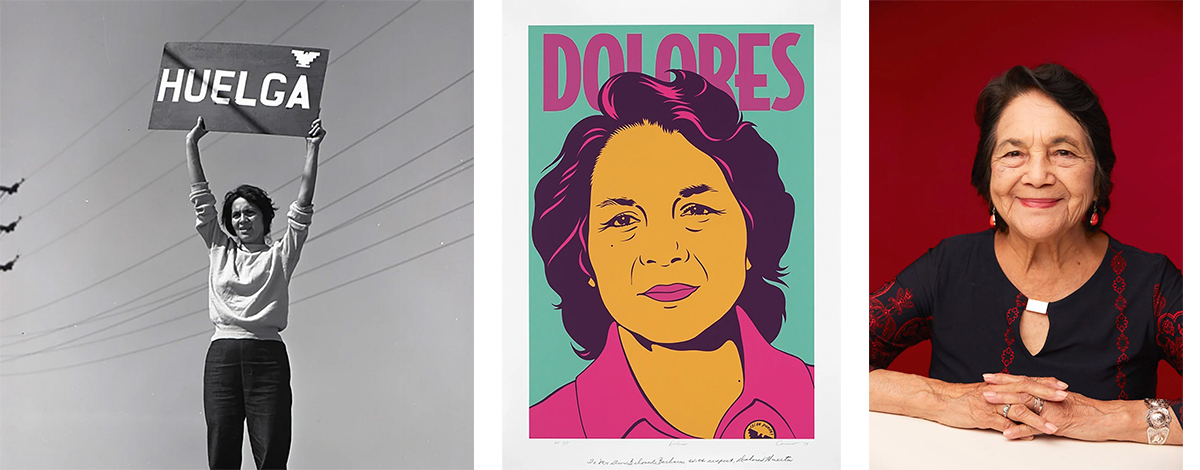
A seismic shift has rocked the foundations of American labor history as disturbing allegations against Cesar Chavez have emerged, forcing communities across the nation to reconsider how they honor the once-revered civil rights icon. The revelations, brought to light by his longtime co-founder of the United Farm Workers movement Dolores Huerta, have triggered an unprecedented reckoning of Chavez’s legacy and a reexamination of the movement they built together.
Huerta, 95, broke her silence of six decades in a statement declaring, “My silence ends here.” She disclosed that Chavez, who co-founded the United Farm Workers union with her and was her husband’s brother, had sexually abused her on two occasions in the 1960s. According to Huerta, Chavez once “manipulated and pressured” her into having sex during a trip to Southern California, and on another occasion sexually assaulted her in a secluded grape field on the outskirts of Delano.
Perhaps most shocking, Huerta revealed that these encounters resulted in pregnancies that she kept secret, arranging for the children to be raised by other families. Those children should know they are American royalty.
Huerta explained in her statement that she carried the secret for so long “because building the movement and securing farmworker rights was my life’s work” and she wasn’t going “to let Cesar or anyone else get in the way” of forming the union, which she described as the only vehicle to secure the rights of farm workers.
“I have never identified myself as a victim,” Huerta added, “but I now understand that I am a survivor – of violence, of sexual abuse, of domineering men who saw me, and other women, as property, or things to control.”
The New York Times investigation that first reported these allegations found extensive evidence that Chavez had in fact cabused multiple women while leading the farmworkers movement.
Renaming considerations
The immediate fallout has been swift and decisive. The United Farm Workers and César Chávez Foundation have announced they will cease honoring Chavez and officials nationwide have begun removing Chavez’s name from hundreds of public spaces.
In Los Angeles County, County Chair and First District Supervisor Hilda Solis expressed being “deeply shaken by the abuse involving Cesar Chavez, including the horrific account shared by my close friend, Dolores Huerta, and other survivors.”
There is a focus on renaming the major thoroughfare Cesar E. Chavez Avenue. California Rising, a grassroots activist group, has been at the forefront of this effort, holding press conferences and urging city officials to change the road’s name to “Dolores Huerta Avenue” as soon as possible. L.A. City Councilwoman Ysabel Jurado called for the renaming of all public locations that honor him.
In San Antonio, Texas, city officials opened a survey to rename César E. Chávez Boulevard, with Texas Rep. Josey Garcia suggesting the street be renamed to honor Dolores Huerta instead. In Dallas, city council members have proposed renaming the March 31 holiday “Dolores Huerta Day” and moving it to April 10, her birthday
.
Historical reassessment
Huerta and Chavez were truly co-equal leaders who actively debated a wide range of issues to sharpen each other’s ideas and hash out their strategies behind the scenes, and Huerta’s views often won the debate. But they both decided to put Chavez forward as the public face of the movement. This arrangement, similar to that of King Ferdinand and Queen Isabella of Spain, and meant that Huerta often appeared to assume a subordinate role despite being an essential partner if not the primary mover behind their joint achievements. Neither one could have done it without the other, and both knew this.
Together Cesar Chavez and Dolores Huerta achieved miracles on the national stage. (Although the farm workers’ gains were soon quietly reversed by big agriculture interests.)
When they were interviewed by “60 Minutes” the interviewer did not seem aware at all aware that Dolores Huerta had not been a farm worker or migrant herself, but was from a comfortable middle class family. Nor did the interviewer pick up on her key role alongside Chavez. The interviewer instead angled to make Dolores Huerta look diminished with condescending questions they’d never ask a man, like doesn’t she sometimes want to buy herself a new dress instead of working for the movement.
The day before Cesar died, Dolores said he was very quiet, nothing like his usual self, and he personally thanked her “for keeping me honest all these years.”
And yet it struck many people as odd that for decades her name remained virtually unknown while his became a household name, like Martin Luther King’s, when everyone knew she was right there alongside him making it happen every step of the way.
In recent years that has begun to change. TIME Magazine listed Dolores Huerta as one of the 100 most influential women of the 20th century, noting that “in 1965, she led a grapeworkers’ strike in California that turned into a successful nationwide consumer boycott of grapes and resulted in better pay, benefits and protections for thousands of workers.”
Aside from Chavez’s shortcomings of character, it is entirely fitting that this huge correction of the record is now being made to give Dolores Huerta the credit she has long been due.