


Page 35 - Adelante Magazine February 2025
P. 35
Entertainment
                                                                                                    By: Laura Moreno


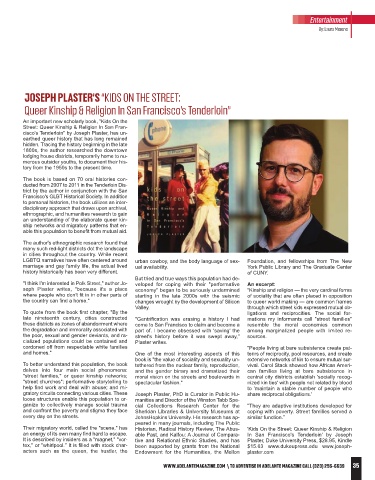
         JOSEPH PLASTER’S “KIDS ON THE STREET:

         Queer Kinship & Religion In San Francisco’s Tenderloin”
        An important new scholarly book, "Kids On the
        Street: Queer Kinship & Religion In San Fran-
        cisco's Tenderloin" by Joseph Plaster, has un-
        earthed queer history that has long remained
        hidden. Tracing the history beginning in the late
        1800s, the author researched the downtown
        lodging house districts, temporarily home to nu-
        merous outsider youths, to document their his-
        tory from the 1950s to the present time.

        The book is based on 70 oral histories con-
        ducted from 2007 to 2011 in the Tenderloin Dis-
        trict by the author in conjunction with the San
        Francisco's GLBT Historical Society. In addition
        to personal histories, the book utilizes an inter-
        disciplinary approach that draws upon archival,
        ethnographic, and humanities research to gain
        an understanding of the elaborate queer kin-
        ship networks and migratory patterns that en-
        able this population to benefit from mutual aid.

        The author's ethnographic research found that
        many such red-light districts dot the landscape
        in cities throughout the country. While recent
        LGBTQ narratives have often centered around   urban cowboy, and the body language of sex-  Foundation, and fellowships from  The New
        marriage and gay family life, the actual lived   ual availability.    York Public Library and The Graduate Center
        history historically has been very different.                         of CUNY.
                                           But tried and true ways this population had de-
        "I think I'm interested in Polk Street," author Jo-  veloped for coping with their "performative   An excerpt:
        seph Plaster writes, "because it's a place   economy" began to be seriously undermined   "Kinship and religion — the very cardinal forms
        where people who don't fit in in other parts of   starting in the late 2000s with the seismic   of sociality that are often placed in opposition
        the country can find a home."      changes wrought by the development of Silicon   to queer world making — are common frames
                                           Valley.                            through which street kids expressed mutual ob-
        To quote from the book first chapter, "By the                         ligations and reciprocities.  The social for-
        late nineteenth century, cities constructed   "Gentrification was erasing a history I had   mations my informants call "street families"
        these districts as zones of abandonment where   come to San Francisco to claim and become a   resemble the moral economies common
        the degradation and immorality associated with   part of. I became obsessed with 'saving' the   among marginalized people with limited re-
        the poor, sexual and gender deviants, and ra-  street's history before it was swept away,"   sources.
        cialized populations could be contained and   Plaster writes.
        cordoned off from respectable white families                          "People living at bare subsistence create pat-
        and homes."                        One of the most interesting aspects of this   terns of reciprocity, pool resources, and create
                                           book is "the value of sociality and sexuality un-  extensive networks of kin to ensure mutual sur-
        To better understand this population, the book   tethered from the nuclear family, reproduction,   vival. Carol Stack showed how African Ameri-
        delves into four main social phenomena:   and the gender binary and dramatized their   can families living at bare subsistence in
        "street families," or queer kinship networks;   moral vision on the streets and boulevards in   central city districts establish 'socially recog-
        "street churches"; performative storytelling to   spectacular fashion."   nized kin ties' with people not related by blood
        help find work and deal with abuse; and mi-                           to 'maintain a stable number of people who
        gratory circuits connecting various cities. These   Joseph Plaster, PhD is Curator in Public Hu-  share reciprocal obligations.'
        loose structures enable this population to or-  manities and Director of the Winston Tabb Spe-
        ganize to collectively manage social trauma   cial Collections Research Center for the   "They are adaptive institutions developed for
        and confront the poverty and stigma they face   Sheridan Libraries & University Museums at   coping with poverty. Street families served a
        every day on the streets.          JohnsHopkins University. His research has ap-  similar function.”
                                           peared in many journals, including The Public
        Their migratory world, called the "scene," has   Historian, Radical History Review, The Abus-  'Kids On the Street: Queer Kinship & Religion
        an energy of its own many find hard to escape.   able Past, and Kalfou: A Journal of Compara-  In San Francisco's  Tenderloin' by Joseph
        It is described by insiders as a "magnet," "vor-  tive and Relational Ethnic Studies, and has   Plaster, Duke University Press, $28.95, Kindle
        tex," or "whirlpool." It is filled with stock char-  been supported by grants from the National   $15.63 www.dukeupress.edu www.joseph-
        acters such as the queen, the hustler, the   Endowment for the Humanities, the Mellon   plaster.com

                                                     WWW.ADELANTEMAGAZINE.COM  \ TO ADVERTISE IN ADELANTE MAGAZINE CALL (323) 256-6639          35

