

By Laura Moreno
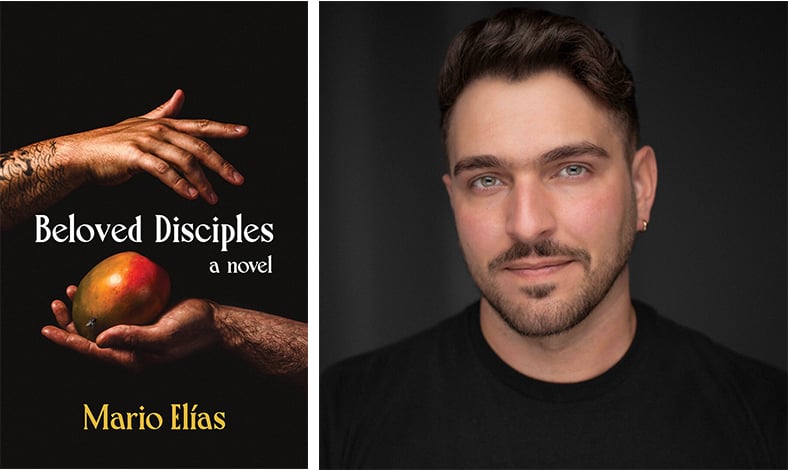
Mario Elías’s debut novel “Beloved Disciples” is about a surreal journey of memory and healing from lost love.
Mario Elías uses a rhythmic, almost hypnotic prose style that is perfect for its genre of magical realism meets psychological/grief fiction.
This is a tale of transformative love between two very different young men who are still at the start of their lives. Polar opposites in many ways, the men meet at the only gay club in their Caribbean town on the coast, the air thick with stifling humidity. To their surprise, a devotion they both knew would last ignites that first night as Simón falls in love, and so does Albi.
Although the pair had never met, they had seen each other in church because Albi was an altar boy. And they had always looked at each other with great interest. A gardener for a local rectory, Albi wants to become a priest.
From the opening page, author Mario Elías demonstrates a willingness to try to understand the depths of his own feelings, and impart his insights.
The novel has an interesting narrative structure in that it goes back and forth in memory to authentically show the main character’s actual process of experiencing and eventually overcoming grief.
Interestingly the author punctuates his writing with the word “Blink” to indicate that he is entering a reverie of the past in his mind’s eye. Through this innovative literary device, Simón relives his romance with his late partner through sensory snapshots. In essence, then, the novel becomes an excavation of a love story that assists in his healing.
The title “Beloved Disciple” is taken from the Gospel of John and underscores that religion is an integral part of the story. The youngest disciple John was called the beloved disciple. John is the one who could be mistaken for a maiden, seated to Jesus’ immediate right side in the painting of the Last Supper.
Author Mario Elías, a photographer and print-maker, is of Cuban and Syrian descent. His visual work has appeared in Vogue and Dazed. He is known for “Queering the Male Gaze,” a collection of essays and self-portraiture that reimagines classical art through a queer lens. He founded the philanthropic KindaSuper Project to assist immigrant families and wildfire survivors.
Architecture of love
At 320 pages, “Beloved Disciples” is not a light read. When Simón is drowning in his grief, he relies on those around him to help. The supporting characters include Tía Cachita, the memorable matriarch of a fractured family, and Lenita, Simón’s best friend. The two women offer the novel’s few moments of comic relief.
Hovering over them is the protagonist’s estranged conservative mother who now reappears with her own agenda. The cast of characters represent the many different responses of the community to queer love, from acceptance to outright rejection to quiet understanding.
As a visual artist, Mario Elías’ writing is reminiscent of the writing of Ocean Vuong. Both authors have a cinematic eye for detail and use powerful imagery, both elevate queer romance to the sacred, both approach prose like poetry, and both authors know that survival for queer men often relies on found family.
Rich imagery is meaningfully interlaced throughout the book, from tactile description of Albi’s hands, rough from gardening, to the way sunlight beam through the stained-glass at the funeral, seeming to strive to offer a ray of hope to the bereaved. Every carefully selected detail, no matter how minute, adds to the story.
As the story reaches its climax, Elias’ prose becomes beautifully lyrical as he blends the sound of the ocean into the cadence of his words. Like the realization that the bare trees are now thick with leaves and spring has arrived, Simón realizes he has made peace with all that has happened. While a measure of grief remains, he has made it to the other side of the dark night and is ready to embark on his new life.
In the final analysis, “Beloved Disciples” is a powerful testament to the eternal nature of love.
“Beloved Disciples” by Mario Elías, Amble Press, $21.95