

By: Laura Moreno
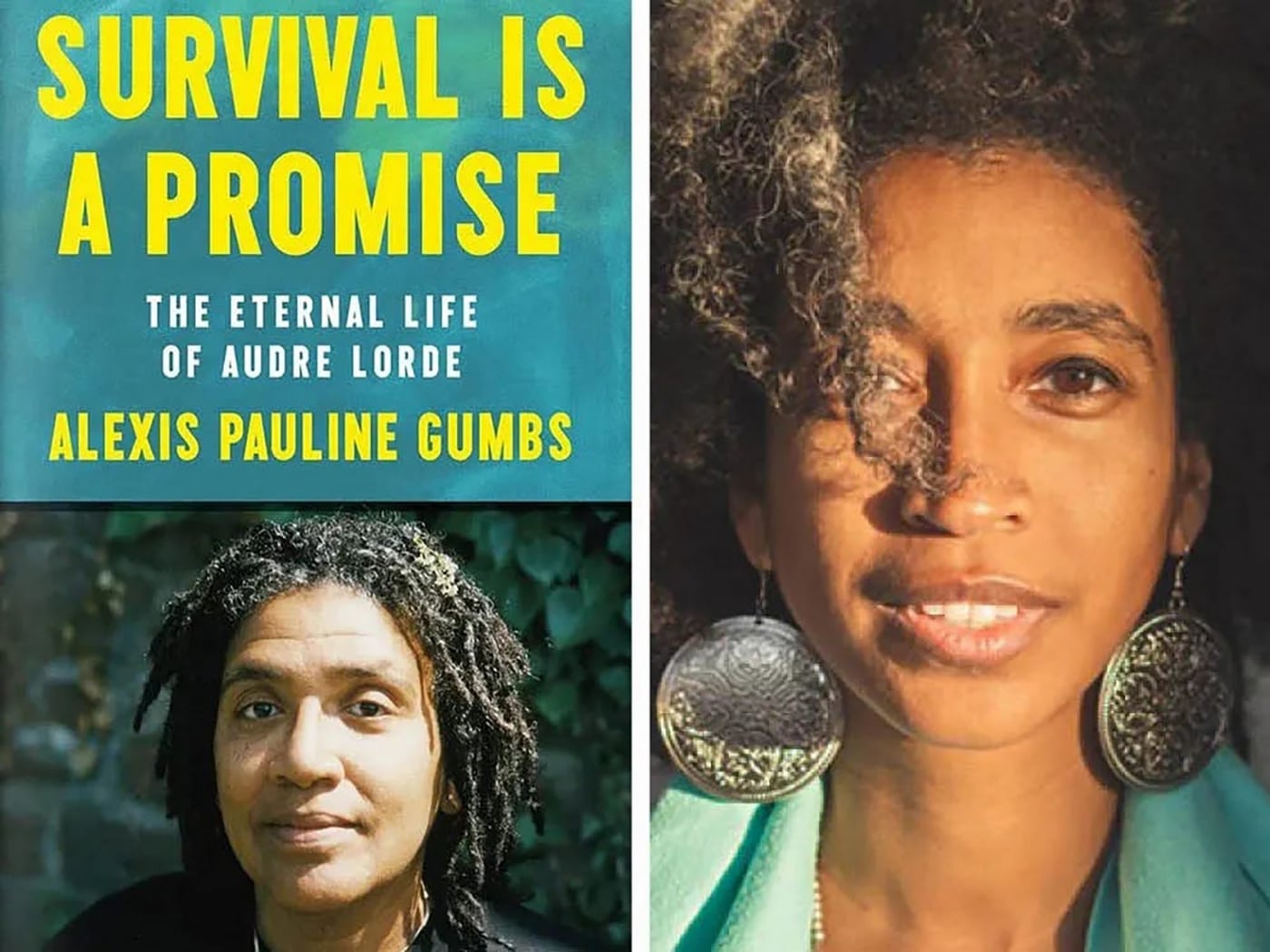
“Survival Is a Promise: The Eternal Life of Audre Lorde” by Alexis Pauline Gumbs is a biography of the life and legacy of the iconic Black feminist poet Audre Lorde. But it is also a literary work that blends meticulous research with poetic prose. Audre Lorde lived a purposeful life as activist and self-described “warrior” in addition to a life of letters.
Winner of the Judy Grahn Award for Lesbian Nonfiction from Publishing Triangle, and a Publishers Weekly Top Ten Book of the Year, “Survival Is a Promise” is a bold, innovative work with an innovative structure. The author is a poet herself. Rather than being a linear, chronological story of her life, the book consists of short, thematic chapters that delve into her childhood in Harlem, her battles with cancer, her activism in the Civil Rights and feminist movements, and her creation of a Black lesbian feminist identity. The result is a groundbreaking biography.
Gumbs is the first researcher to draw upon Lorde’s journals and letters in the Spelman College Archives, uncovering lesser-known facets of Lorde’s life, such as her time living in Mexico in the 1950s and details of the founding of her publishing company Kitchen Table: Women of Color Press in 1980 with Barbara Smith, Beverly Smith, and Cherríe Moraga.
The author also conducted interviews with Lorde’s partner Gloria Joseph to craft a vibrant narrative that powerfully conveys Lorde’s importance in the canon.
Survival’s song
Gumbs learned two powerful lessons from Audre Lorde. First, we don’t need to be afraid of our power. And we don’t need to be afraid of our love. These lessons make themselves known throughout the book in various ways at various times of Lorde’s life.
Equally compelling is Gumbs’s ability to contextualize Lorde’s radicalism. The book vividly illustrated Lorde’s role as a bridge between Civil Rights, second-wave feminism, and queer liberation. For example, she insisted on intersectionality before the term existed.
In a 1979 speech at NYU, Lorde declared, “Your silence will not protect you.” This quote, woven into Gumbs’s analysis, underscores Lorde’s view that survival demands vocal resistance, a message that resonates in today’s fractured social landscape.
In Mexico, Audre Lorde found freedom. She studied at the National University of Mexico (UNAM) and discovered that Black Americans abroad are seen primarily as Americans, a concept she found liberating. The less racially hostile society freed her to enter a time of self-exploration and have a relationship with Eudora Garrett, her first significant queer relationship.
In addition, she found Mexico’s post-revolutionary spirit reminiscent of her Grenadian roots, sparking political and personal insights that shaped her activism and made their way into her book “Zami: A New Spelling of My Name” (1982).
Breaking silence
Gumbs also explores “The Cancer Journals” (1980) in which she reclaims her agency through writing. This section of the book includes painterly scenes of Lorde writing in her Staten Island home, surrounded by books, meditating on her private fears and her determination to live fully, even refusing to hide her mastectomy.
The power of her writing about cancer lies in its balance of intimacy and universality. Gumbs doesn’t shy away from Lorde’s vulnerability, moments of despair, and exhaustion. It also connects Lorde’s personal struggle to her activism. Somehow, cancer deepened her commitment to intersectional feminism, as she linked her health struggles to environmental racism and clear healthcare disparities.
A particularly moving chapter recounts Lorde’s time in St. Croix with her partner. Basking in the Caribbean sun and lush landscape was a healing experience. Gumbs’s prose evokes the “salt air and mango trees” Lorde wrote about in her journals.
In light of all that has since been revealed about the medical industrial complex, including that the most prestigious high-priced cancer hospitals have the same abysmal survival rate as anywhere else, the question arises as to whether her diagnoses was real (how sick was she really before being put through grueling “treatment“?) or perhaps was it an insidious way of setting her back and trying to silence her?
“Survival Is a Promise” is a timely book. Lorde’s call to dismantle oppressive systems feels urgent today, making Gumbs’s work essential reading. Its emotional depth and intellectual heft make it a literary triumph.
‘Survival Is a Promise: The Eternal Life of Audre Lorde’ by Alexis Pauline Gumbs, Farrar, Straus and Giroux.