

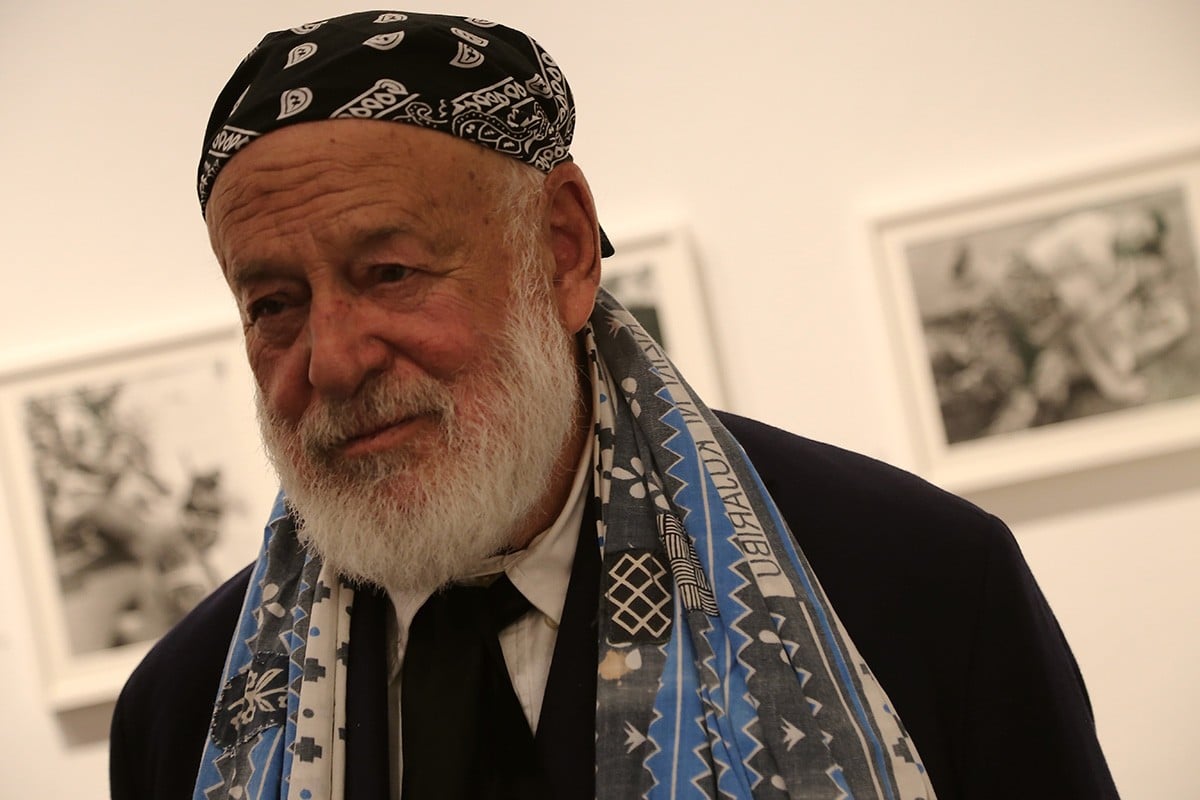
Article and Photos by: Phantom Street Artist


Bruce Weber’s lovely-titled exhibition, “Try a Little Tenderness,” with its subtle nuance, premiered at Fahey/Klein Gallery on La Brea. The show introduced a transgenerational aesthete as a push-button master with a vast language of creativity who, for decades, has expressed himself to no end. The exhibition opened on Thursday evening, April 9th, 2026, and will run through June 6, 2026. Its exhibition showcased decades of Weber’s retrospective work, celebrated by fashion, portraiture, and film, beautifully framed as a signed visual memoir of his personal, artistic, and emotional influences.
Weber’s visual poetry, with its panoptic sensibility, is revolutionary, framed by his innate ability to relate. The outstanding exhibition was an intimate confession letter captured through the mapping of his emotional and testimonial Weberesque terrain. Under the direction of its Senior Gallery Director and arbiter David Fahey, the exhibition positioned itself less as a chronological survey and more so as a retrospective meditation that defined how an American flaneur artist and photographer was shaped by his close proximity to his circle of family, lovers, collaborators, and the quiet rituals of his everyday life.
What distinguishes this visionary exhibition from others is the author’s insistence on ‘tenderness’ as both his calling, his expression, his form, his subject, and his method. Weber’s images, long associated with the surface signs of fashion through nostalgia, ask you to take a closer look at his photographs, revealed, recovered, and recontextualized as deeply personal artifacts. As a youth, he was gifted with an Argus C3 camera, which became his symbolic voyage to Mecca, placed in the hands of a young visionary ingenue, not as a technical instrument, but as an emotional awakening prayer that became his spiritual journey. Bruce Weber was born to be a storyteller with an imperishable vision that reverberates the practice of his sensitivity throughout the show, where even the most stylized compositions carry a level of intensity. Through expression, Weber suggests that he has never abandoned the idealized backyard vantage point of his youth. The curatorial narrative leans heavily on Weber’s pedagogical lineage, invoking his formative mentored influences to Diane Arbus and Lisette Model. Their presence is less about direct stylistic inheritance and more about an ethos practice, with an ethical and forever commitment to being present as a photographer. His revelation shares that his muses are collective subjects, not as objects in silence or in absence, but as a collective of collaborators who are staged as allied creators. This is crucial, especially when considering Weber’s later commercial success, which often risked aestheticizing youth and beauty to its mythos. The exhibition answers the search for the miraculous of seeking tenderness by asking, ‘Where is it?’
Weber answers by being a teacher of form, teaching the reconciliation of opposites, where tenderness is hidden beneath the world of appearance, with a reflective, endless surface that is consistent with his sensitivity. In this Weberesque context, Try a Little Tenderness is less of an act than its actuality, through its reframed exhibition gestures toward an intimation of vulnerability. Weber is apolitical, who rarely interrogates power, particularly the dynamics between the photographer and his subject in images that are traded as youth and the idealized bodies of his prized wrestlers and fighters.
Weber’s vision has also transitioned into film, especially with its classic release of Let’s Get Lost, which is affectionately presented as an extension of his photographic genius. It is Weber who stages an expansion of his fascination with the seduction of charisma, fragility, and mythmaking. The inclusion of filmic references enriches the exhibition’s thesis, positioning Weber as a prolific and empathetic cinematic storyteller expressed across countless span of time, crossing platforms and mixed media. Visually, the exhibition succeeds in creating an atmosphere of warmth and nostalgia. ‘Sunlit bodies, windswept landscapes, and quiet, unguarded moments’ accumulate to an emotional pathos.
There is undeniable beauty here, which begins through the talent of his frank sincerity. Weber’s command of light and composition remains ever so seductive and persuasive. Ultimately, yes, it is Bruce Weber who asks you to try a little tenderness, pointing to where it is, as the most compelling Barthian sign. Weber proposes tenderness as the answer, not the question. But Bruce here is the philosophical guide who practices a ‘be rare’ principle, with a more simple revelation of how tenderness can be mediated and marketed through commerce, through memory, through the act of looking, and through the theatrical look of being seen. Weber’s philosophy is the engaged renewal of seeing as a non-violent protestor with resistance, to counteract political authoritative regimes via social institutional change. For spiritual viewers and followers of Bruce Weber, the exhibition offers more than just a retrospective; it becomes a site of radical change supported by critical analysis and reflection on the very conditions that it is produced as a moment of intimation, beginning with a simple act of seeing.
In alignment with Weber’s release of his book titled My Education (published by TASCHEN), the exhibition also included a Saturday afternoon book signing party, packed by his supporters with an intimate lecture gifted by his endless entertaining stories that celebrated his imperishable vision. Bruce’s vision is that of a prolific author who encourages you to feel safe in a world that has somehow forgotten to feel. But like any memoir, his expression is selective, curated, and made self-aware. The question Bruce leaves us is not simply how such a visionary Weber was formed, but how he will be remembered as the legendary photographer that he is, as a man who has expressed a lifetime of feelings, so tender.
Bruce Weber’s ‘Try a Little Tenderness’ April 9 through June 6, 2026