

By: Laura Moreno
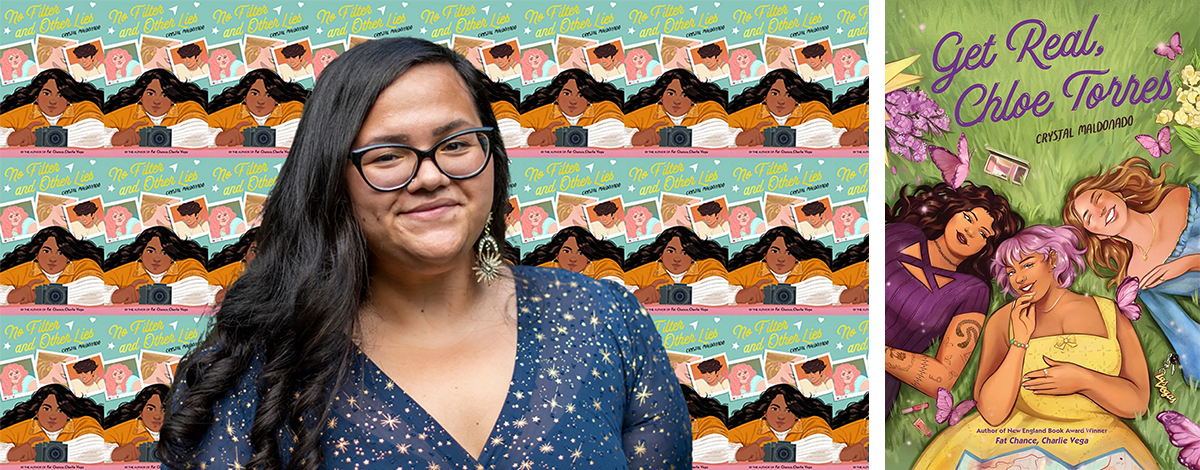
In Crystal Maldonado’s vibrant young adult novel “Get Real, Chloe Torres,” published in May 2025 by Holiday House, a Latina teenager embarks on a cross-country summer adventure with good friends. The book is an endearing coming-of-age novel that captures the thrill and uncertainty of being on the precipice of entering adulthood.
At the center of the novel is Chloe Torres, a queer, plus-size high school graduate about to turn 18. She is preparing to attend the Rhode Island School of Design, which makes her acutely aware that the bonds of adolescent friendship are about to be tested by time and distance.
When she scores VIP tickets to a reunion concert in Las Vegas by her favorite boy band, she seizes the moment. Chloe and two friends, Sienna and Ramona, plan a road trip from Massachusetts hoping to renew the closeness they once shared. Years earlier, the trio’s bond was fractured after a stolen kiss between Chloe and Ramona introduced uncertainty into what had been effortless camaraderie.
As the girls visit unforgettable places like Niagara Falls, the emotional terrain grows increasingly complex. Chloe finds herself drawn to Sienna, who identifies as pansexual, while Ramona, a lesbian with a reserved demeanor, still has feelings for Chloe. The author deftly allows the complex mix of feeling among them to simmer and surface gradually.
Chloe’s narration is witty and self-aware, marked by sarcasm, and a running commentary on fandom culture and social media. Her clever observations stay with the reader: “Sometimes my brain seems to have a mind of its own” and “If social media taught me anything, it’s that my life needs a soundtrack and a constant stream of likes”.
The road-trip gives the girls room to think about family expectations and personal ambitions as well as their own shared history. Maldonado’s prose is particularly effective in evoking the sensory texture of summer travel: the heat of long car rides, the thrill of roadside attractions, and the cathartic release of live music.
The author’s writing style is confident, solid, energetic and firm-footed, keeping the reader anchored in Chloe’s point of view. Sentences tend to be short and straightforward. This simplicity works in the novel’s favor, allowing moments of uncertainty, impulsiveness, and honesty to land without explanation or apology.
The plot also includes ADHD representation, manifesting as Chloe’s impulsivity and organizational struggles, adding another layer of meaning.
Drawing on her background as a first-generation Latina growing up in Massachusetts and a graduate of the University of Massachusetts Amherst, Maldonado crafts a story grounded in her own lived experience.
Heart and humor
Friendship and belonging emerge as central themes in the book. And to be sure, friendship is very much facilitated by humor. The subtle humor interwoven throughout the narrative is one of the best aspects of Maldonado’s writing. Chloe’s interior commentary captures the awkwardness and immediacy of youth, but always with the healthy perspective of a good sense of humor, even or especially about oneself.
This strength of being able to step back and look at oneself is particularly important for marginalized teens who may have to navigate issues of exclusion and stereotyping. Maldonado’s blend of laughter and emotional candor allows her to tackle important issues like queer joy, body acceptance, and the fear of growing apart in a manner a wide range of readers will find engaging.
The novel’s treatment of queer identity is similarly grounded. The diverse cast of characters includes Chloe’s gay cousin Diego, a long-lashed drag queen who provides comic relief, aligning with Maldonado’s stated mission: to create stories where all sorts of marginalized youth “can see themselves and feel empowered.”
The novel’s emphasis on fandom as a unifying force resonates especially in a post-pandemic era, where collective experiences like concerts offer a balm for isolation. Indeed, from the first page the dedication reflects this idea, “To my fellow fangirls, who love with their whole hearts,” signaling the novel’s understanding of fandom as both emotional and cultural anchor.
All in all, “Get Real, Chloe Torres” is a refreshing read, reminiscent of road-trip classics in the vein of Sarah Dessen’s work, but with an inclusive twist. Ultimately, it is an ode to the exhilarating threshold between adolescence and whatever comes next. An impactful read that leaves readers with a sense of warmth and possibility for what the future holds.